Portfolio
About Me
Contact
Digital Promotional Flyers
Digital Promotional Flyers
Digital Promotional Flyers
Exploring how digital promotional flyers could be made more inclusive, accessible and user-friendly for older customers.
Exploring how digital promotional flyers could be made more inclusive, accessible and user-friendly for older customers.
TIMELINE
March – June 2026
March – June 2026
Client
Coop Sverige AB
Coop Sverige AB
ROLE
UX Designer & Researcher
UX Designer & Researcher
TOOLS
Figma
Miro
Figma
Miro
Participants
7 Coop members aged 60+
7 Coop members aged 60+
My contribution
Led the study from research planning and participant sessions to thematic analysis, synthesis and research-informed redesign.
Led the study from research planning and participant sessions to thematic analysis, synthesis and research-informed redesign.

Context
Context
Context
The grocery retail sector is increasingly shifting from printed to digital promotional flyers, changing how customers find and engage with offers. As part of my thesis, I led a UX research and design project in collaboration with Coop’s UX design department, exploring how older customers experience this transition and how digital promotional flyers could be made more inclusive and easier to use.
The grocery retail sector is increasingly shifting from printed to digital promotional flyers, changing how customers find and engage with offers. As part of my thesis, I led a UX research and design project in collaboration with Coop’s UX design department, exploring how older customers experience this transition and how digital promotional flyers could be made more inclusive and easier to use.
Challenge
Challenge
Challenge
As Coop transitions from printed to digital promotional flyers, the challenge was to understand how this shift affects older customers and identify usability and accessibility barriers that could contribute to digital exclusion.
As Coop transitions from printed to digital promotional flyers, the challenge was to understand how this shift affects older customers and identify usability and accessibility barriers that could contribute to digital exclusion.
Process
Process
Process

Research question
Research question
Research question
How do older customers experience the transition from printed to digital promotional flyers in the grocery retail sector?
How do older customers experience the transition from printed to digital promotional flyers in the grocery retail sector?
Research approach
Research approach
Research approach
Seven Coop members aged 60+ participated, evaluating both Coop’s digital promotional interface and a digital version of the printed flyer.
A qualitative case study combined semi-structured interviews with exploratory think-aloud usability testing to understand user needs, pain points, habits, behaviours, preferences and attitudes towards printed and digital flyers.
Findings were analysed through thematic analysis to identify recurring behaviours, usability issues and accessibility barriers. These insights were then translated into redesigns of the existing digital experiences.
Seven Coop members aged 60+ participated, evaluating both Coop’s digital promotional interface and a digital version of the printed flyer.
A qualitative case study combined semi-structured interviews with exploratory think-aloud usability testing to understand user needs, pain points, habits, behaviours, preferences and attitudes towards printed and digital flyers.
Findings were analysed through thematic analysis to identify recurring behaviours, usability issues and accessibility barriers. These insights were then translated into redesigns of the existing digital experiences.

Interview and usability-test observations were coded and synthesised through thematic analysis, resulting in five key themes, twelve subthemes and associated codes.
Key findings
Key findings
Key findings
Acceptance of digital solutions did not always translate into digital behaviour
Participants recognised the benefits of digital flyers, particularly easier access and reduced paper use. However, familiar analogue habits remained strong, especially when planning purchases and writing shopping lists.
Acceptance of digital solutions did not always translate into digital behaviour
Participants recognised the benefits of digital flyers, particularly easier access and reduced paper use. However, familiar analogue habits remained strong, especially when planning purchases and writing shopping lists.
2. Familiarity and personal connection shaped behaviour
Familiar routines, proximity to the local store and personal interaction influenced how participants engaged with Coop and its services. Adoption was therefore shaped by more than usability alone.
2. Familiarity and personal connection shaped behaviour
Familiar routines, proximity to the local store and personal interaction influenced how participants engaged with Coop and its services. Adoption was therefore shaped by more than usability alone.
3. Better overview and navigation were needed
The website was easier to navigate than the PDF flyer, but long scrolling and an easily missed filter made offers harder to find. Participants needed clearer categorisation and stronger visual guidance.
3. Better overview and navigation were needed
The website was easier to navigate than the PDF flyer, but long scrolling and an easily missed filter made offers harder to find. Participants needed clearer categorisation and stronger visual guidance.
4. The PDF flyer created visual overload
Small text, strong colours and dense visual information made the flyer difficult to scan. A clearer hierarchy, more consistent structure and fewer competing visual elements were needed.
4. The PDF flyer created visual overload
Small text, strong colours and dense visual information made the flyer difficult to scan. A clearer hierarchy, more consistent structure and fewer competing visual elements were needed.
Redesign
Redesign
Redesign
The research findings were translated into redesigns of both Coop’s website and digital promotional flyer.
The research findings were translated into redesigns of both Coop’s website and digital promotional flyer.
Website
Website
Website
The website was reorganised to make offers easier to scan and navigate.
The website was reorganised to make offers easier to scan and navigate.
Key improvements:
Clarifying product categories to make offers easier to find.
Making the filtering function more prominent.
Reducing the size of the promotional video so that offers appeared earlier on the page.
Increasing the number of product cards per row to provide a better overview and reduce scrolling.
Key improvements:
Clarifying product categories to make offers easier to find.
Making the filtering function more prominent.
Reducing the size of the promotional video so that offers appeared earlier on the page.
Increasing the number of product cards per row to provide a better overview and reduce scrolling.

Before: Existing Coop interface

After: Redesigned interface
Before: Existing Coop interface
After: Redesigned interface
Digital promotional flyer
Digital promotional flyer
Digital promotional flyer
The promotional flyer was redesigned to reduce visual overload and make offers easier to scan.
Key improvements:
Replacing strong striped backgrounds with a neutral background.
Grouping products into clearer, more consistent rows.
Using consistent card sizes.
Strengthening the visual hierarchy to make products and prices easier to distinguish.
The promotional flyer was redesigned to reduce visual overload and make offers easier to scan.
Key improvements:
Replacing strong striped backgrounds with a neutral background.
Grouping products into clearer, more consistent rows.
Using consistent card sizes.
Strengthening the visual hierarchy to make products and prices easier to distinguish.
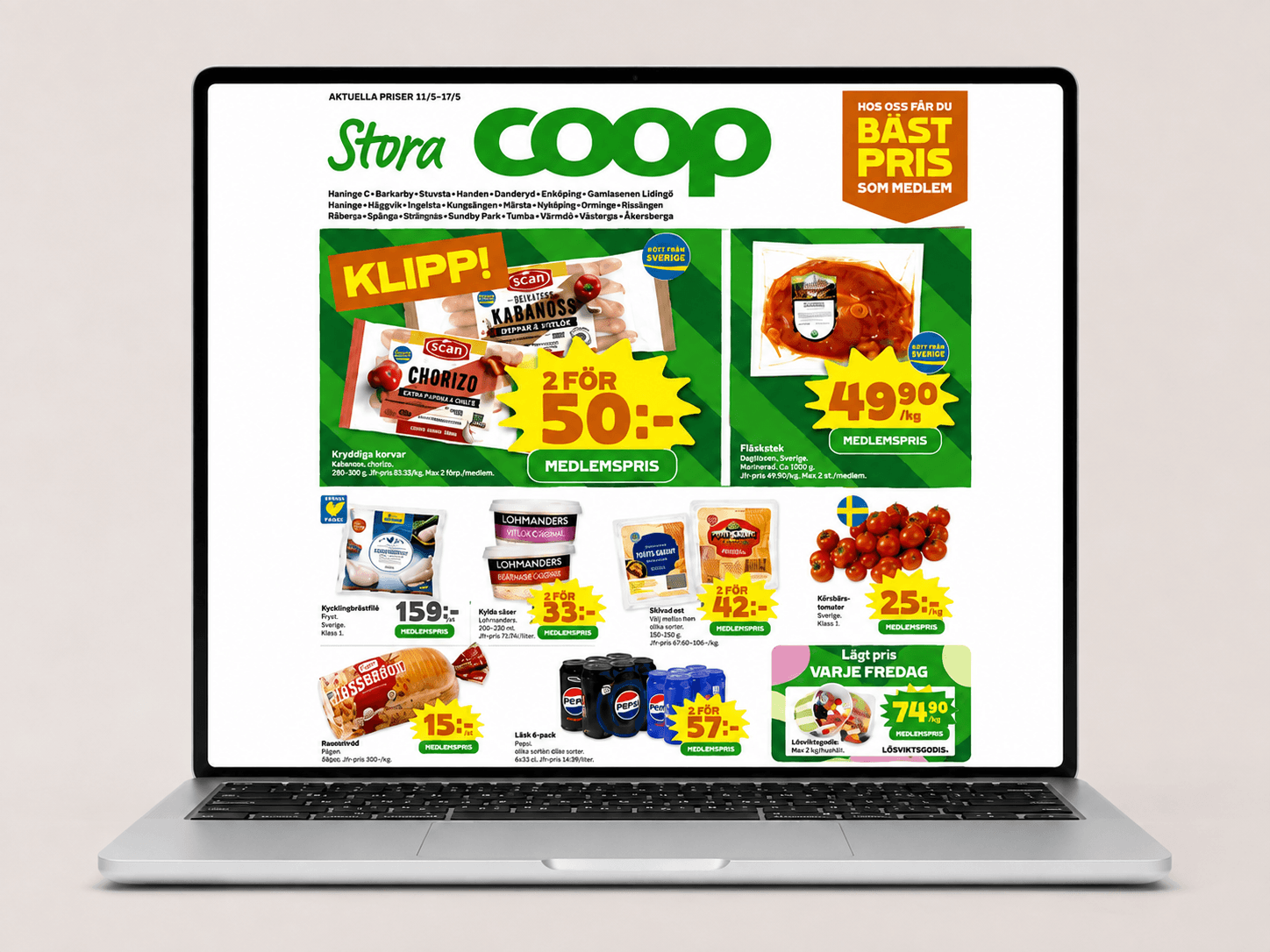

Before: Existing digital promotional flyer
After: Redesigned promotional flyer
Before: Existing digital promotional flyer
After: Redesigned promotional flyer
Outcome
Outcome
Outcome
The project resulted in two research-informed redesign concepts addressing the usability and accessibility barriers identified during the study.
The project resulted in two research-informed redesign concepts addressing the usability and accessibility barriers identified during the study.
Reflections
Reflections
Reflections
The project showed that older users’ engagement with digital services was shaped by more than digital confidence. Familiar habits, personal values and perceived value also played an important role in adoption.
Given more time, I would test and iterate on the redesigned interfaces and include participants with varying levels of digital experience to better understand different accessibility needs.
The project showed that older users’ engagement with digital services was shaped by more than digital confidence. Familiar habits, personal values and perceived value also played an important role in adoption.
Given more time, I would test and iterate on the redesigned interfaces and include participants with varying levels of digital experience to better understand different accessibility needs.
Back to top
View more projects


Let’s Connect
Let’s Connect
Let’s Connect
Have a role, project, or design problem in mind?
Have a role, project, or design problem in mind?
Have a role, project, or design problem in mind?
I would be glad to hear about it. Reach me directly or connect through LinkedIn.
I would be glad to hear about it.
Reach me directly or connect through LinkedIn.
© 2026 Amanda Schultz. All rights reserved